Pre rolls sit at the center of today’s cannabis market. They sell fast, turn inventory quickly, and attract repeat buyers.Many dispensaries rely on them as daily volume drivers. For producers, pre rolls support steady cash flow and predictable demand.
This popularity creates pressure. Orders rise week after week. Launch dates tighten. Wholesale buyers expect reliable supply. What starts as a strong product line often becomes the most stressful part of production.
Growth exposes weak points. Pre rolls require precision, repetition, and speed. As volume increases, small inefficiencies turn into daily problems. Teams feel the strain first on labor and quality. This is where many producers realize growth brings friction, not relief.
The Limits of Hand Rolled Production
Hand rolling works early. Small batches stay manageable. Teams control quality by eye and feel. At low volume, this approach stays flexible.
As demand grows, hand production hits hard limits.
Each added unit needs more hands. Each new hire needs training. Each shift depends on human consistency. These factors drive costs upward at the same pace as volume.
Common problems appear.
• Labor hours rise faster than output
• Training takes longer with each hire
• Weight variance increases
• Rework becomes routine
• Managers spend time correcting mistakes
Manual systems rarely fail overnight. They wear down slowly. Margins shrink bit by bit. Schedules slip. Stress builds across the floor. By the time teams look for change, they already feel behind.
Why Traditional Automation Felt Out of Reach
Automation solves many of these issues. It improves speed, repeatability, and control. For years, it remained an option reserved for large operators.
Enterprise systems deliver high throughput. They also demand large budgets, dedicated staff, and long setup cycles. Many growing producers fall between two extremes.
They outgrow hand production. They lack the scale for enterprise automation.
This gap forces tough choices. Teams hire more people instead of improving process.
Overtime replaces efficiency. Consistency depends on perfect execution from tired crews.
STM observed this pattern across markets. The issue was not interest in automation. The issue was access.
The Automation Gap Holding Producers Back
The production landscape stayed split.
On one side stood manual labor. It brought flexibility but limited scale. On the other stood enterprise systems. They brought power but required heavy investment.
Between them sat a wide gap.
Producers inside this gap faced constant tradeoffs.
• Add headcount or miss deadlines
• Accept variation or slow output
• Delay launches or risk quality
This gap was not technical alone. It was economic and operational. Producers needed a way to automate without overbuilding. They needed control without excess.
This gap shaped the reason RollCraft exists.
Why STM Created RollCraft
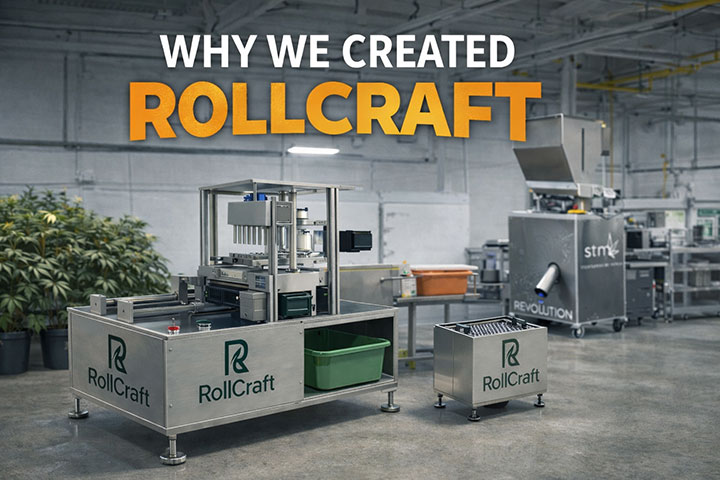
STM built RollCraft to bring practical automation to more producers. The goal stayed clear from the start.
Deliver proven automation principles at a scale that fits lighter workloads.
RollCraft was designed for teams growing beyond hand production. It supports producers who need stability, not complexity. It focuses on the most critical production steps, where automation delivers immediate relief.
RollCraft was not built as a cheaper version of enterprise equipment. It was designed as its own product line with a specific role.
• Support growing brands
• Reduce labor dependence
• Improve consistency
• Lower financial risk
RollCraft expands access without changing what automation stands for.
Solving the Core Problem of Labor Dependence
Labor sits at the center of most pre roll challenges. Even modest volume demands constant staffing. Each person introduces variability. Each shift depends on focus and stamina.
As volume grows, labor scales poorly.
More people create more management overhead. Training cycles repeat. Turnover disrupts output. Labor costs rise faster than revenue.
RollCraft targets this issue directly.
By automating core steps, teams reduce reliance on manual labor. Output stabilizes. Staffing needs flatten. Operators focus on supervision and quality, not repetitive motion.
The result is not only higher output. It is predictable output.
Consistency as a Business Requirement
Consistency is no longer optional. Modern cannabis markets demand it.
Wholesale buyers expect uniform weight and finish. Regulators expect accuracy. Brands depend on trust built through repeat experience.
Hand rolling introduces variation by nature.
• Weight drift between operators
• Loose or tight packs
• Inconsistent finishes
• Higher reject rates
As volume rises, these issues become visible and costly.
RollCraft applies mechanical consistency at the craft scale. Each cycle follows the same process. Each unit meets the same standard. Teams deliver uniform pre rolls batch after batch.
This level of consistency supports brand growth and long term relationships.
Designed for Operators on the Floor
RollCraft was built with daily operators in mind.
Smaller teams do not have automation engineers or maintenance departments. Equipment must be intuitive, reliable, and easy to learn.
Design priorities stayed practical.
• Fast setup
• Short training time
• Clear operation
• Minimal excess features
Every design decision answered one question. Does this help an operator produce better pre rolls tomorrow.
If the answer was no, it did not belong in the system.
Modular Growth Without Overcommitment
Many producers fear overbuying. Large systems lock teams into capacity they do not need yet. This fear delays automation.
RollCraft avoids this trap through modular design.
Teams start with what solves today’s problem.
• Filling
• Packing
• Closing
As volume grows, capabilities expand. Investment follows real demand, not forecasts.
This approach protects cash flow and limits risk. Producers stay flexible while gaining control.
Why Pre Roll Automation Shapes the Future
Pre rolls will remain central to cannabis business models. Demand continues to rise across markets. Competition increases. Margins tighten.
Producers who succeed share common traits.
• Controlled costs
• Stable quality
• Deliberate scaling
• Early automation
RollCraft supports these goals. It helps teams automate before pressure becomes urgent. It replaces reactive decisions with planned growth.
Automation stops being a last resort. It becomes a strategic step.
Scaling That Feels Like Progress
RollCraft exists to change how producers experience growth.
Instead of adding stress, growth brings stability. Instead of chasing labor, teams focus on output and quality. Instead of guessing, decisions follow data and repeatable process. Pre roll automation should feel like progress, not pressure. RollCraft was built to make that possible.
Is RollCraft Right For You?
After reading this article, you should have an idea of whether or not RollCraft is the right choice for your growing cannabis business or not. If you are interested in learning more about our products, please reach out to one of our cannabis pre roll machinery experts today!
No responses yet