Manual pre-roll teams bleed money in slow, repeatable ways. A three-person table that outputs 1,200 cones per shift can cost $350 to $700 a day in labor alone, before rework and rejects. One machine decision changes that math fast.
You are probably comparing the King Kone pre-roll machine to RollCraft MRB because you want more output without hiring a second crew.
This breakdown stays focused on what hits margins: cycle time, labor touches, consistency, and what it takes to scale past your first production ceiling.
Quick answer for buyers
Choose King Kone when:
- You want a tabletop cone filling setup for small batches and flexible runs.
- You are fine with more manual handling steps between filling, packing, and closing.
- Your target is “batch speed” more than continuous repeatable cycles.
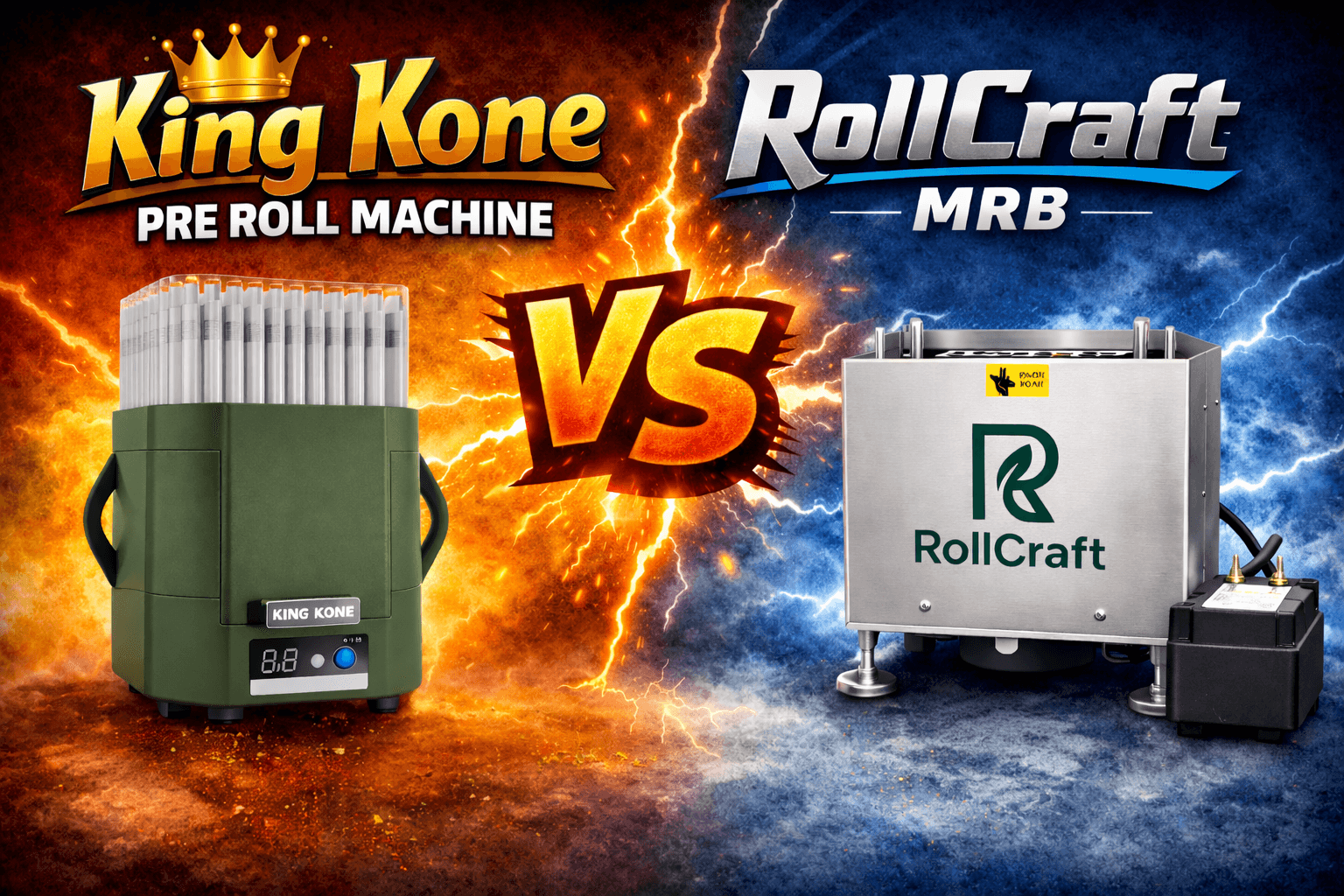
King Kone is marketed as a compact pre-roll filling machine that can fill up to 169 cones in under three minutes.
Choose RollCraft MRB when:
- You want repeatable cycle output with less operator finesse.
- You want to skip pre-weighing as a standard step.
- You want higher hourly capacity from short-run cycles.
RollCraft MRB is rated to pack 72 or 143 pre-rolls in 90 seconds and uses a 44 ft-lb centrifugal filling system with 72-count tray compatibility.
What production looks like on a real shift
Most pre-roll programs hit the same wall. The wall is labor churn and variability.
A typical day includes:
- Grind and sift variance that changes density by lot
- Tray loading speed that swings by operator
- Pack consistency that drifts late in the shift
- Rework that piles up right before fulfillment deadlines
One jam, one loose pack batch, or one bad close run can burn 30 to 90 minutes of the day.
That is why cycle time matters more than top-end claims.
King Kone workflow and where labor stays on the table
King Kone is positioned as a tabletop cone-filling machine that handles multiple cone sizes and runs batch fills. It is promoted with outputs like 1,000+ pre-rolls per hour and batch metrics like 169 cones in under three minutes.
That batch format has upsides.
- Easy to drop into an existing bench workflow
- Good for short runs and frequent SKU swaps
- Simple for teams that live in trays all day
The tradeoff is labor touches.
Teams still handle:
- Filling the top tray consistently across cavities
- Leveling and tamping decisions by the operator
- Extra handling steps if you are moving from fill to close using separate tools and trays
You can run King Kone fast.
You still rely on operator rhythm to keep weight drift and loose packs under control.
If your crew already has strong SOP discipline, this setup can work well for small-to-mid output.
RollCraft MRB cycle output and why it changes daily planning
RollCraft MRB is built around short, repeatable production cycles. The brochure calls out 72 or 143 pre-rolls packed in 90 seconds, plus a 44 ft-lb centrifugal filling system and “even, repeatable packing without pre-weighing required.”
Let’s turn that into hourly capacity.
- 72 cones per 90 seconds equals 72 cones per 1.5 minutes.
- 60 minutes per hour divided by cycles per hour.
- 40 cycles times 72 cones equals 2,880 cones per hour.
At the 143-count run:
- 40 cycles times 143 cones equals 5,720 cones per hour.
Those numbers matter because they make scheduling simple. You plan the day in cycles, not in “how fast is my best operator today.”
Do you want predictable output even when you rotate staff? You get it by removing finesse steps, not by pushing people harder.
Consistency, rejects, and compliance pressure
Loose packs and weight drift hit you twice.
They trigger rework now, and they tri.
Consistency shows up in:
- Fewer cones that need a second tamp
- Fewer finished goods held back for “too loose” checks
- Better burn performance across lots
RollCraft MRB is positioned around “consistent fill” and “repeatable packing without pre-weighing required.”
King Kone positions consistency through its tray system and uniform filling approach, with vendors highlighting uniform packs.
The practical difference is where your QA time goes.
- Batch systems push more QA burden onto the operator.
- Short cycle systems push more QA stability into the machine action.
Both can pass compliance checks.
One takes fewer operator corrections to stay inside spec.
Decision guide by production stage
If you run under 10,000 cones per week
King Kone can fit well. You stay close to the bench, keep batches tight, and avoid a big process change.
If you run 10,000 to 40,000 cones per week
RollCraft MRB starts to make more sense. The cycle speed gives you schedule control, and the “no pre-weighing required” positioning removes a common slow step.
If you run multi-shift and fight staffing
RollCraft MRB’s repeatable cycle concept aligns better with rotating crews. You get less performance swing between operators.
FAQs
How many cones can King Kone fill?
King Kone is commonly sold in a format that fills 169 cones per run.
How many cones can the RollCraft MRB fill?
**How fast is RollCraft MRB per cyc is listed at 72 or 143 pre-rolls packed in 90 seconds.
Does RollCraft MRB require pre-weighing?
No.
The step that settles the decision
Calculate your current weekly waste and rework cost using this formula:
Weekly waste cost = (Reject rate × Weekly cones × Flower grams per cone × $ per gram)lly loaded $ per hour)
Run it with your last two weeks of batch logs, not your best week.
The next question is capacity planning for your nextlesale deadlines.
Comments are closed