
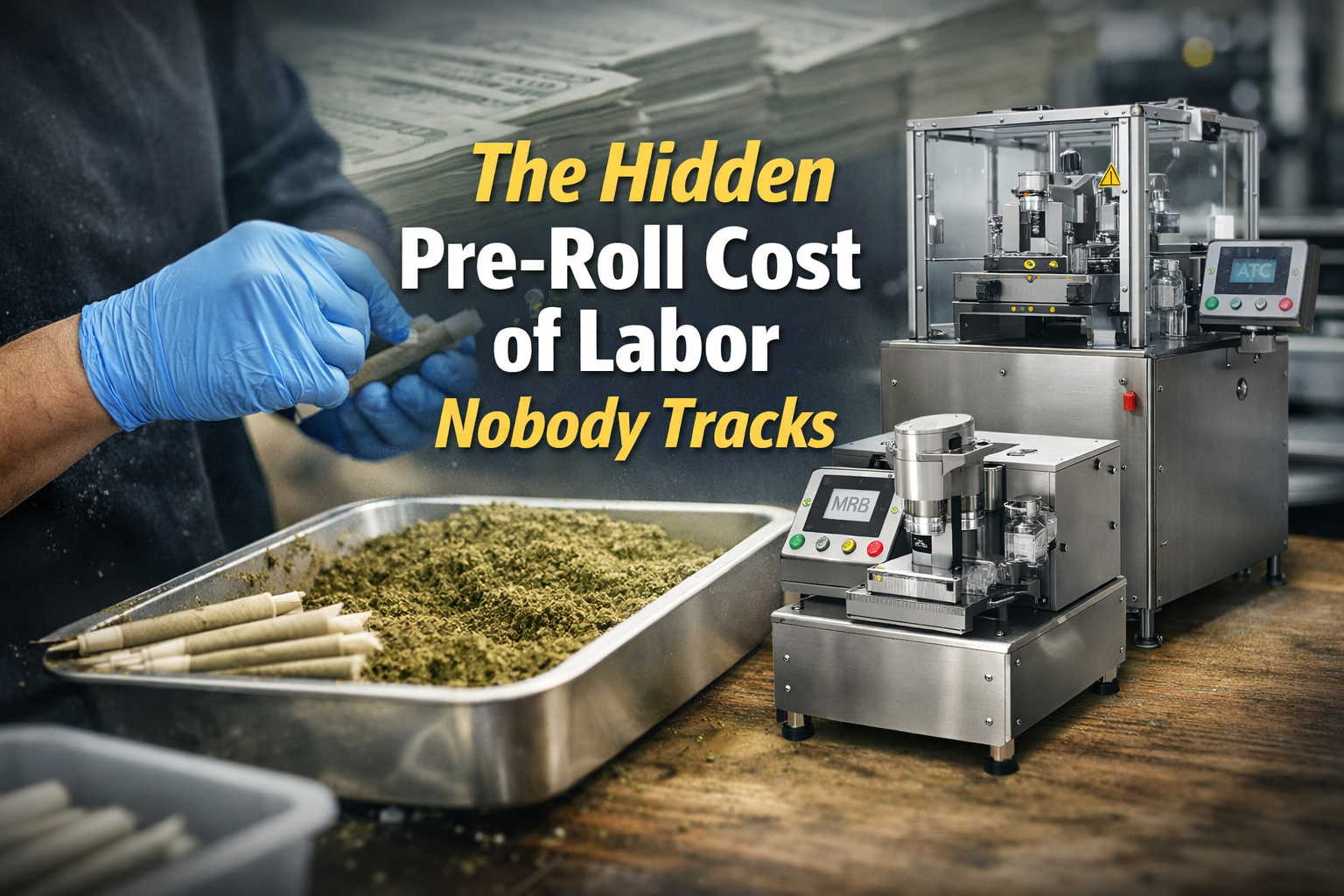
Hand-filled pre-rolls don’t fail because people stop caring.
They fail because labor hides in places no one logs.
Most operators track cones, flower, and packaging. They track rejects if compliance demands it. They track hours in payroll. They rarely track labor the way a production floor feels it.
That gap gets expensive fast.
And it gets worse the moment volume jumps from 500 a day to 5,000 a day.
This article breaks down the hidden labor costs teams miss, the numbers to track, and the simplest way to get control back. You’ll also see a clear automation path that fits craft and mid-market producers without forcing a giant all-in-one system.
Hidden pre-roll cost of labor 1: Rework time that never hits a spreadsheet
Teams log “rejects.” They don’t log “touches.”
A pre-roll that gets touched twice costs more than a pre-roll that gets scrapped once.
Here’s a clean example.
- Daily run: 4,000 pre-rolls
- Rework rate: 5%
- Rework count: 200 pre-rolls
- Time per rework: 45 seconds
- Labor time burned: 150 minutes, which is 2.5 hours
That’s one person losing a third of a shift.
And the shift still ends at the same time.
Rework also steals focus. It breaks rhythm.
It’s like trying to cook dinner while someone keeps resetting the stove timer.
Track this weekly: rework minutes per 1,000 pre-rolls.
If it rises for 2 weeks, your process lost control.
Hidden pre-roll cost of labor 2: Weight checks and “micro-pauses” across the day
Manual work includes hundreds of small stops.
Each stop feels harmless. Together, they eat the day.
Common micro-pauses include:
- scale checks every 10 to 25 units
- tamp adjustments every 5 to 15 minutes
- fixing loose packs every 20 to 40 units
- swapping grind that runs too fine or too wet
If a line pauses for 30 seconds every 8 minutes, that’s:
- 7.5 pauses per hour
- 225 seconds per hour, which is 3.75 minutes
- across an 8-hour shift, that’s 30 minutes lost
Half an hour disappears with no single “problem” to blame.
That’s why nobody tracks it.
Track this daily: total pause minutes per shift.
One person can mark a tally on a whiteboard. That’s enough.
Hidden pre-roll cost of labor 3: Training time that repeats every time someone leaves
Turnover doesn’t just replace a person.
It replaces muscle memory.
New hires learn by slowing the line. Your best operator becomes a trainer. Quality dips while everyone pretends it won’t.
Example math that hits many facilities:
- New hire ramp time: 10 shifts
- Lost output during ramp: 15% of the line
- Daily target: 3,000 pre-rolls
- Daily loss: 450 pre-rolls
- Total loss over ramp: 4,500 pre-rolls
That’s not a “people issue.” That’s production capacity bleeding out.
It’s like filling a bucket with a crack in the bottom.
Track this monthly: ramp shifts per new hire, plus output loss during ramp.
If you can’t estimate it, you’re paying it.
Hidden pre-roll cost of labor 4: Supervision and management overhead nobody assigns to pre-rolls
When production gets messy, labor grows in the shadows.
A lead steps in to fix issues. A manager comes down to triage. Someone from QA gets pulled into the room. Those hours land in “salary” or “overhead,” so pre-rolls look cheaper than they are.
Try this quick reality check:
- Lead time on pre-roll issues: 1.5 hours per day
- QA support: 45 minutes per day
- Manager interruptions: 30 minutes per day
- Total hidden labor: 2.75 hours per day
- Weekly total: 13.75 hours
That’s almost 2 shifts every week.
Your cost per pre-roll never reflects it.
Track this weekly: support hours spent on pre-roll production by role.
Hidden pre-roll cost of labor 5: Changeovers between SKUs that get treated like “just part of it”
SKU growth sells product. SKU growth also taxes labor.
A changeover includes cleaning, new cones, new labels, new SOP checks, and new weight targets. Even when it’s smooth, it takes time.
Example:
- Changeovers per day: 4
- Minutes per changeover: 18
- Total changeover time: 72 minutes
- That’s 1.2 hours lost each day
Changeovers feel normal. They still cost real money.
It’s like driving a route with four extra red lights. You arrive late every day, then blame traffic.
Track this daily: changeover minutes and changeover count.
Hidden pre-roll cost 6: Overtime that turns into a habit
Overtime looks like a short-term fix.
It turns into a permanent line item.
If you run:
- 10 overtime hours per week
- overtime premium: 1.5x
- base pay: $22 per hour
- overtime pay: $33 per hour
- weekly overtime cost: $330
- annual overtime cost: $17,160
That’s one category of hidden spend. It doesn’t include burnout, errors, or turnover.
Overtime also changes behavior.
The team starts planning around it. That’s when hand-filled pre-rolls stop scaling for real.
Track this weekly: overtime hours tied to pre-roll production.
Hidden pre-roll cost of labor 7: Compliance pressure that turns quality issues into expensive delays
In tighter markets, consistency isn’t a nice-to-have.
It’s a business requirement.
When weights drift or closures fail, you don’t just lose product. You lose time. You lose scheduling certainty. You lose trust with wholesale buyers who expect repeat orders to match.
This shows up as:
- extra inspections
- extra documentation
- extra holds while someone verifies a fix
- extra rework that turns into a late shipment
A one-day delay can break a launch window.
That’s not dramatic. It’s normal.
Track this monthly: hold events, hold hours, and the root cause category.
The easiest way to track real pre-roll cost of labor
Start with one number that forces honesty.
True labor cost per 1,000 pre-rolls
Use this formula:
- Total paid hours on pre-rolls this week
- Plus support hours on pre-rolls this week
- Plus rework hours on pre-rolls this week
- Divide by total pre-rolls produced
- Multiply by 1,000
Then multiply hours per 1,000 by a fully loaded labor rate. Many teams use $28 to $40 per hour once taxes and benefits enter the picture.
This is the number that exposes the truth.
It also tells you where automation pays first.
Where modular automation stops the bleeding
All-in-one pre-roll machines target giant operations. Craft and mid-market teams get squeezed by the size, cost, and fixed capacity. That mismatch traps smaller producers in labor.
RollCraft exists to close that gap. It brings real automation to teams who assumed it was out of reach, without forcing an oversized system.
Two steps matter most for labor.
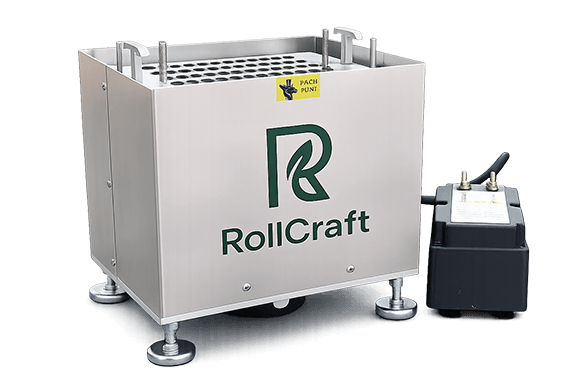
Step 1: Fix filling flow
The RollCraft MRB pre-roll filling machine is $3,500, runs up to 143 pre-rolls per minute, weighs 26 lbs, and uses patented Nitrogen Enhanced Particle Lock filling technology. It also removes the need for pre-weighing.
Pre-weighing time often acts like a toll booth.
Removing it changes the whole day.
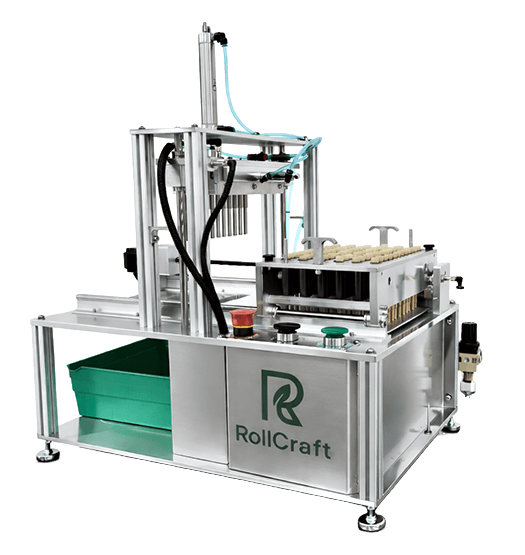
Step 2: Fix closing repeatability
The ATC automated Dutch Crown closing machine is $24,995.
Closing issues create rework, stoppages, and quality drift.
A repeatable closer reduces touches and stabilizes scheduling.
The modular advantage
- Start with one machine
- Add capacity as production grows
- Avoid replacing equipment when demand increases
RollCraft is Made in America with durable non-plastic construction built to last. It’s built for craft and mid-market producers, not large-scale enterprises. STM’s broader pre-roll automation track record includes 1B+ pre-rolls processed, work with 50% of the top 20 U.S. pre-roll companies, and deployments across 44 states and 14+ countries.
RollCraft just started shipping, so there’s no published RollCraft customer ROI dataset yet. Use labor math, throughput, and STM’s track record to frame the business case.
Pre-Roll Cost of Labor FAQs
What is the hidden cost of pre-roll labor?
Rework, training, changeovers, supervision time, micro-pauses, and overtime that never gets assigned to pre-rolls.
How do I calculate true labor cost per pre-roll?
Add direct hours plus support and rework hours, divide by units produced, then multiply by your loaded hourly rate.
What causes pre-roll labor to spike as volume grows?
SKU changeovers, quality drift, turnover, and bottlenecks at filling and closing.
What’s a low-risk first step toward automation for craft producers?
Start with modular automation that targets the biggest labor bottleneck first, then add steps as volume rises.
The next step that makes this real
Pick one week. Track the 7 hidden costs above with simple tallies.
Then calculate true labor hours per 1,000 pre-rolls.
If that number surprises you, you’re normal.
Most teams feel the cost before they can see it.
If you want a fast fit check, bring your weekly number to a walkthrough. You’ll get a straight answer on whether modular filling, modular closing, or both should come first. If you want to learn more about this topic, please consider reaching out to us today!
Comments are closed