Many cannabis brands start the same way. A few hundred pre-rolls per day. A small team. Hand processes that feel manageable. Then demand climbs. Orders stack up. Labor hours stretch. The math stops working.
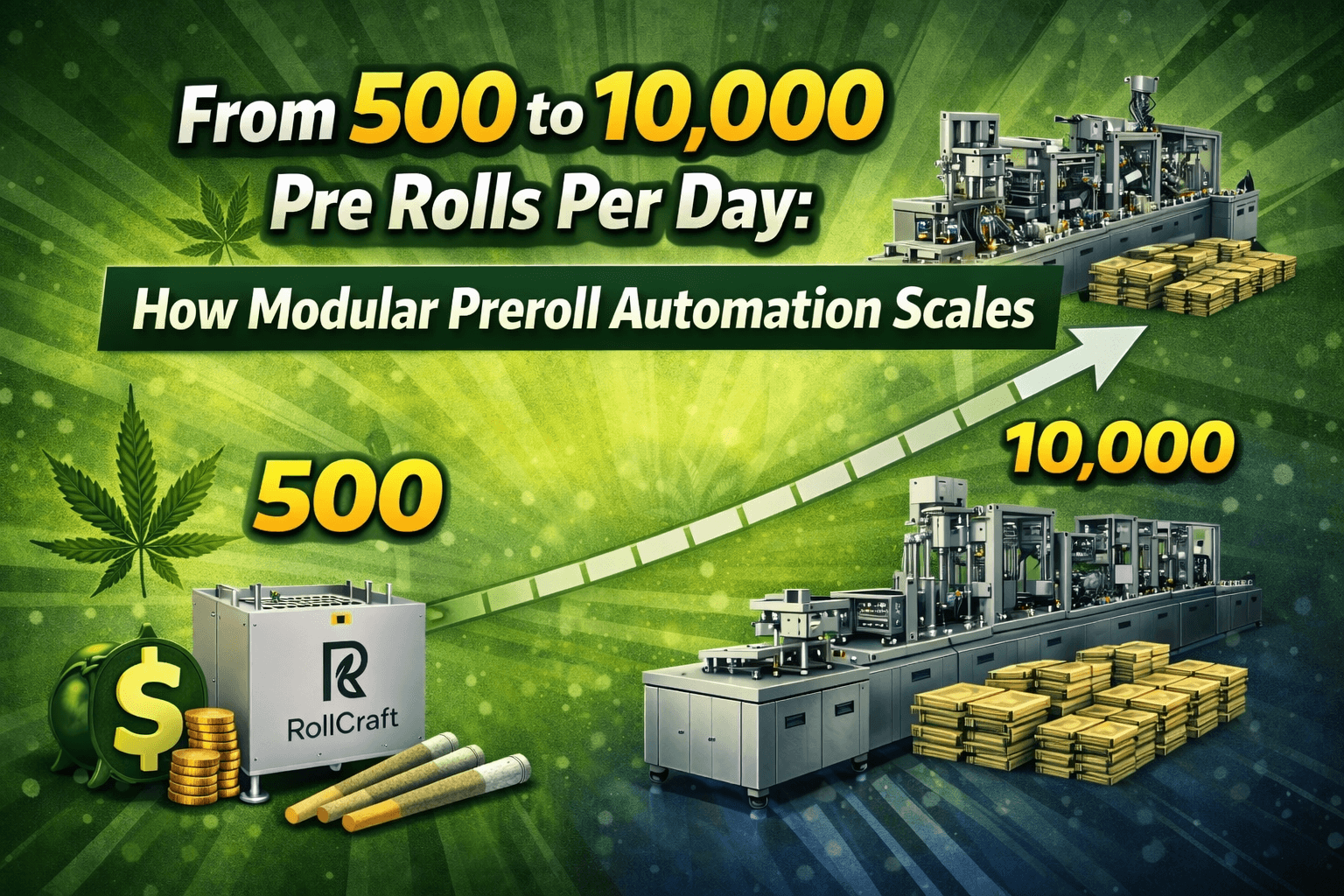
The jump from 500 pre-rolls a day to 10,000 is not a single leap. It is a series of controlled steps. Modular automation makes those steps possible without breaking workflows or cash flow.
This is where the RollCraft MRB and ATC matter most.
Modular preroll automation: The early stage problem is at 500 pre-rolls a day
At 500 pre-rolls per day, most teams rely on manual filling and finishing. Two to four operators can usually keep pace. Quality depends on experience and attention. Output rises only by adding people or overtime.
This stage feels flexible, but cracks already show. Weight variance creeps in. Training new staff takes time. One sick day slows the entire line. Costs rise faster than output.
Many operators stay here longer than planned. Automation feels too big. Full-scale systems seem oversized. The result is a delay.
STM Canna saw this pattern across markets and built RollCraft to address it.
Why modular preroll automation changes the scaling equation
Modular systems let teams automate one problem at a time. Instead of replacing the whole line, operators add targeted capacity. Each module solves a clear bottleneck.
This approach lowers risk. It keeps learning curves short. It ties capital spend to real demand rather than forecasts.
The MRB and ATC were designed with this exact path in mind.
Modular preroll automation step one: stabilizing output with the RollCraft MRB
The RollCraft MRB focuses on the most labor-intensive step: filling and packing. This is where inconsistency and fatigue show up first.
By automating filling, teams lock in repeatable weights and tighter packs. One operator can oversee what once took several people. Training time drops. Rework drops.
Daily output often moves from 500 to 2,000 pre-rolls without adding headcount. The line still feels familiar. Operators stay in control. The difference is steadiness.
The MRB uses STM-backed mechanical principles, scaled for lighter-duty production and craft environments.
Modular preroll automation: Labor math at this stage
Consider a team producing 500 pre-rolls per day with three operators over eight hours. That is roughly 21 pre-rolls per person per hour.
With the MRB in place, the same team can push well beyond 1,500 per day. Labor per unit drops. Schedules tighten. Managers regain predictability.
This is often the first moment automation pays for itself in labor savings rather than future growth promises.
Modular preroll automation step two: Preparing for growth without disruption
As output climbs past 2,000 pre-rolls per day, new pressure appears. Finishing and closing become the next constraint. Even with consistent fills, hand finishing slows everything down.
This is where teams face a choice. Add more people or add another module.
The ATC answers that choice.
Modular preroll automation step three: finishing at scale with the RollCraft ATC
The RollCraft ATC automates closing and finishing with the same focus on consistency and repeatability. It integrates cleanly with MRB-fed workflows and existing tables or conveyors.
With the ATC in place, teams remove another manual step. Output becomes smoother end-to-end. Quality holds steady across long runs.
At this stage, daily production often reaches 5,000 pre-rolls with the same core crew. Supervisors shift from firefighting to planning.
The ATC was built for this exact expansion point, not as a full-line replacement but as a focused capacity add.
What changes operationally at 5,000 joints per day with modular preroll automation
At 5,000 units per day, the business looks different. Orders ship on time. Wholesale partners trust consistency. Inventory planning improves.
Most importantly, growth no longer depends on finding and training more labor. It depends on scheduling and material flow.
This is the point where many brands realize they can keep scaling without chaos.
Modular preroll automation step four: Scaling toward 10,000 without overbuilding
Moving from 5,000 to 10,000 pre-rolls per day does not require a new system. It requires duplication and layout planning.
Teams often add a second MRB, a second ATC, or both. Lines can run in parallel. Shifts can extend without doubling staff.
Because each module is familiar, ramp time stays short. Maintenance stays simple. Operators move between stations with confidence.
This modular expansion protects cash flow. Capital spend follows confirmed demand. No excess capacity sits idle.
Consistency becomes a business requirement with modular preroll automation
At higher volumes, consistency is no longer about pride. It is about contracts and compliance. Buyers expect uniform weight, draw, and finish across thousands of units.
Manual processes struggle here. Human variation shows up fast.
The MRB and ATC apply mechanical repeatability at a scale that fits growing brands. This keeps rejection rates low and brand trust intact as volume rises.
Modular preroll automation designed for operators, not engineers
One reason modular scaling works is usability. Smaller teams do not have automation engineers on staff. They need systems that train fast and run clean.
RollCraft systems focus on straightforward setup, clear operation, and predictable maintenance. This reduces downtime and reliance on specialists.
Operators learn by doing. Managers plan with confidence.
Protecting flexibility as markets change with Modular preroll automation
Markets shift. SKUs change. Demand spikes and dips. Modular automation keeps lines flexible.
Teams can reconfigure layouts, pause expansion, or add capacity without rewriting the entire operation. This matters in an industry shaped by regulation and price pressure.
STM designed RollCraft to support this reality rather than fight it.
The real modular preroll automation lesson from 500 to 10,000 per day
Scaling pre-roll production is not about buying the biggest machine available. It is about removing constraints in the right order.
The MRB addresses filling and packing.
The ATC handles closing and finishing.
Together, they form a clear path from hand production to serious volume.
Each step delivers value on its own. Each step prepares the next.
For brands aiming to grow without losing control, modular preroll automation is not a compromise. It is a strategy built for how cannabis businesses actually scale.
The jump from 500 to 10,000 pre-rolls a day is not a leap of faith. With the right modules in place, it is a series of steady, repeatable moves.
Comments are closed