Pre roll machine lines lose money in boring ways. Not the big stuff. The small stuff. A slow fill. A shaky weight. A closer that needs one more “quick tweak” every 20 minutes.
Let’s make it real with one number.
If your team loses 45 minutes per shift to rework and resets, that’s 3.75 hours a week on a single station. At $25 per hour fully loaded labor, that’s about $4,875 a year per person, per station. Add a second operator and you’re staring at $10,000 in “nothing happened” time.
Now the real question.
Are you building a craft line that needs a budget-friendly speed boost, or are you building a production room that needs stable throughput, day after day, across a lot of SKUs?
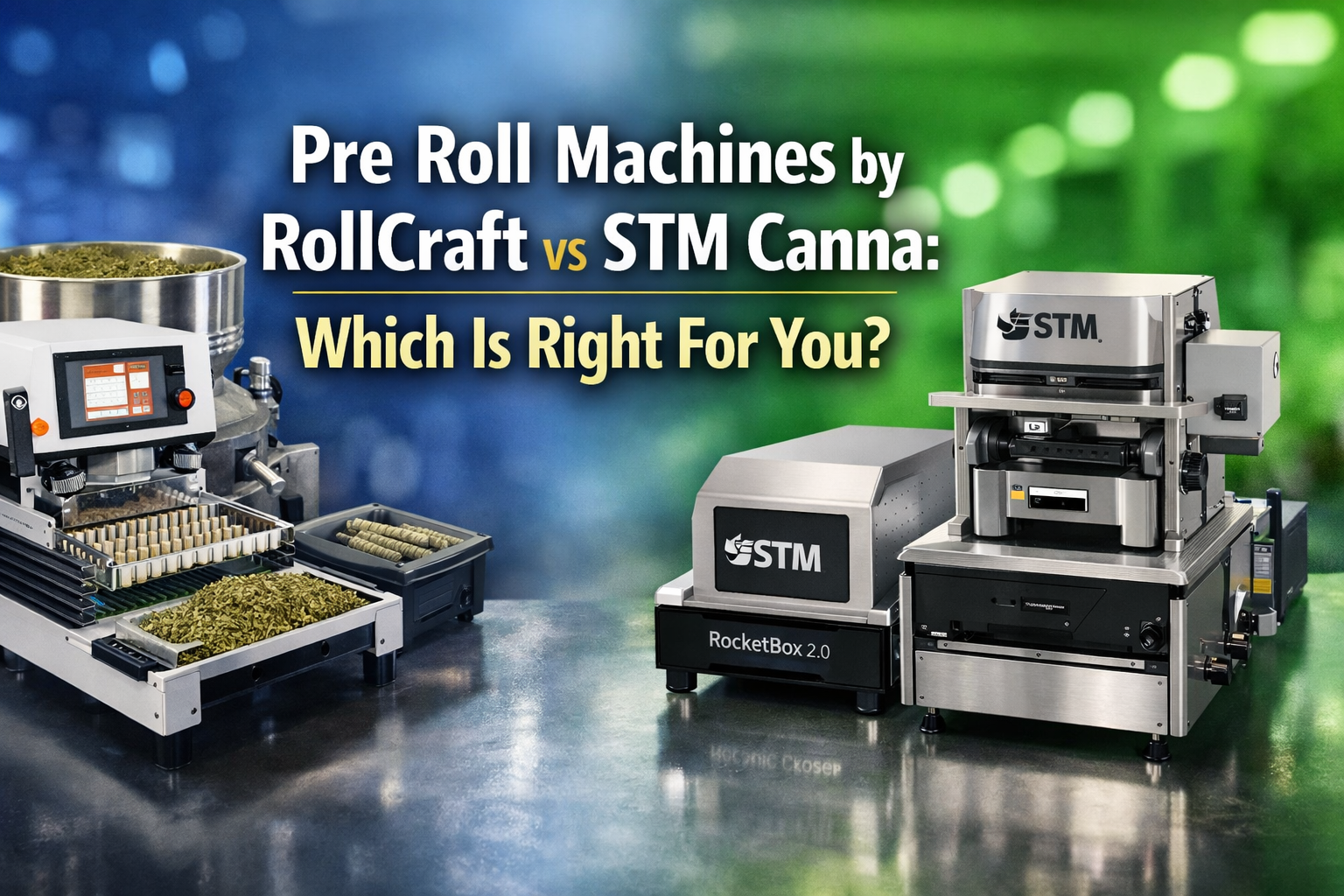
That’s the difference between RollCraft and STM Canna.
STM Canna manufactures pre-roll production equipment in the United States and operates out of Spokane Valley, Washington, with modular pre roll machine options meant to work in a tray-based workflow.
RollCraft is STM’s secondary brand built for craft and budget-focused producers using simplified versions of STM technology at lower price points.
1. Quick answer for pre roll machine buyers in a rush
Choose RollCraft if:
- You’re stepping up from hand-filling and tabletop knockboxes
- You want a low-cost first automation purchase
- You can live with lower throughput and fewer “production room” features
Choose STM Canna if:
- You run daily volume that punishes downtime
- You need repeatable output across multiple SKUs and cone sizes
- You want a modular line that scales from grind to fill to weigh to close
RollCraft is a smart entry ramp.
STM is the line you build your margins around.
2. Throughput is not the only number that matters in a pre roll machine
People love asking “how many pre-rolls per hour?” because it’s clean. Real production is messy.
Here’s what the brands publish that’s useful for planning.
RollCraft MRB (filling)
- Lists at $3,500
- Packs 72 or 143 pre-rolls in about 90 seconds
- Spec sheet lists up to 1,250 pre-rolls per hour and up to 10,000 per day
That’s a big jump from hand packing. It fits a small room. One operator can keep it moving.
STM RocketBox Pro (filling)
- Fills up to 3,000 cones per hour, depending on cone size and workflow
- STM notes many operators average 2,400 to 2,800 cones per hour on 1-gram SKUs in real production
That “real production average” line matters. It means the number is grounded in day-to-day use, not just a perfect demo run.
So yes, STM runs faster.
What you’re buying is the ability to hold speed while your day gets weird. Strain swaps. Humidity swings. New hire on station 3. A rush order for dog walkers right after lunch.
3. Cost and risk feel different on day one depending on the pre roll machine you choose
This is where RollCraft wins for a lot of teams.
A $3,500 filler is a low-risk way to stop burning payroll on hand packing. If you’re doing micro-batches and weekly drops, you don’t need to swing for the fences.
RollCraft also positions itself as “affordable pre-roll automation from STM Canna.”
That said, the minute you start planning around real daily quotas, the math changes fast.
Let’s do a simple labor picture.
Say you want 6,000 pre-rolls per day on a single shift.
- With a craft-scale machine rated up to 1,250 per hour, you’re in the ballpark with strong operator pace and clean material flow.
- With a commercial filler rated up to 3,000 per hour, you can hit the same daily number with more breathing room for weighing, QC checks, and tray handling.
Breathing room is where quality lives.
It’s also where compliance lives. Weight checks. Batch records. Less “we’ll fix it later.”
4. Your real pre roll machine bottleneck is usually not filling
Most pre-roll rooms don’t fail because the filler is slow.
They fail because the line is unbalanced.
You fill faster, then you stack trays. Then your team hand-weighs one-by-one. Then you hand-close. Then you hand-pack. Now your fast filler just created a pile of work.
STM leans into modular stations so you can build a real tray workflow.
A few examples that show why that matters.
Closing speed
STM’s Atomic Closer Turbo marketing notes crown speeds up to 4,250 joints per hour.
That’s the difference between “closing is a second shift problem” and “closing stays in the flow.”
Weighing for QC
Retail listings for the LaunchPad describe weighing a full tray of 72 in a single cycle that takes only a few seconds.
If you’ve ever watched a team hand-weigh 72 pre-rolls, you know why this is a big deal. The scale becomes the pace car for the whole room.
RollCraft has a closing option too, like the RollCraft ATC being positioned as a cost-effective Dutch crown closer. That’s solid for craft. For high volume, you’ll care a lot about cycle consistency across a long shift, not just “it closes.”
5. A practical way to choose between STM and RollCraft pre roll machine options
Here are the four questions I’d ask if we were walking your production floor.
1) What’s your daily quota, really?
- Under 3,000 per day and you’re still finding product-market fit for pre-rolls, RollCraft can make sense.
- Over 6,000 per day and you’ll feel the pain of limited headroom. That’s where STM starts paying you back.
RollCraft MRB lists up to 10,000 per day.
STM RocketBox Pro lists up to 3,000 per hour.
Those are very different planning tools.
2) How many SKUs do you run per week?
More SKUs means more changeovers. More tray swaps. More label checks. More chances to screw up a batch record.
Faster “on paper” doesn’t help if your crew is stopping to reset all day.
3) Do you sell on weight consistency or on price?
If you sell premium singles and infused drops, weight variance shows up as brand damage. Customers notice. Budtenders notice first.
If you sell value packs, weight consistency still matters, because waste eats margin fast.
4) Are you building a line, or buying a machine?
RollCraft is often a machine purchase.
STM is usually a line decision. Fill, weigh, close, and keep the tray flow clean across the day. That’s the play.
6. ROI example with real numbers you can plug in
Let’s keep this simple and honest.
Assume:
- 1 operator costs $25/hour loaded labor
- You run 8 hours per shift
- You produce 6,000 pre-rolls per day
Labor minutes saved is where ROI starts.
If automation saves 2 hours of hands-on time per day, that’s:
- 2 hours/day × $25/hour = $50/day
- $50/day × 5 days/week = $250/week
- $250/week × 52 weeks = $13,000/year
That’s only labor.
Now add waste.
If you run 1-gram pre-rolls and you waste 2 percent through spills, overfills, and rework, that’s:
- 6,000 grams/day × 2% = 120 grams/day
If your finished margin value is $2 per gram, that’s: - 120 × $2 = $240/day
That’s $62,400/year on a 5-day schedule.
Even if your real numbers are half of that, it’s still not small.
This is why teams “outgrow” craft automation fast.
7. FAQ
Is RollCraft owned by STM Canna?
RollCraft is a secondary brand built by STM for craft and budget-focused producers, using simplified versions of STM technology.
How fast is the RollCraft MRB pre-roll machine?
STM materials and retailer listings describe up to 1,250 pre-rolls per hour, up to 10,000 per day, with 72 or 143 packed in about 90 seconds.
How fast is the STM RocketBox Pro?
STM states the RocketBox Pro fills up to 3,000 cones per hour, and notes many operators average 2,400 to 2,800 cones per hour in real production on 1-gram SKUs.
What is the best pre-roll machine for small cannabis businesses?
If you’re leaving hand-filling and you need a low-cost first step, RollCraft is built for that lane. If your demand is steady and your room runs daily quotas, STM’s commercial machines fit better because they give you more headroom and a clearer path to a full tray workflow.
Why do weighing and closing matter as much as filling?
A fast filler can create a pile of trays that still need QC weights and consistent crowns. That’s why high-throughput stations like tray weighing and automated closing show up in serious pre-roll rooms.
8. The next step: calculate your “waste tax” in 60 seconds
Use this formula on your last full production week:
Waste tax per week = (pre-rolls per week × target grams per pre-roll × waste percent) × margin value per gram
If that number is bigger than your monthly equipment payment, you already know which direction you’re headed.
This article should have given you a firm foundation of information to help you decide which pre roll machines are right for you. But, if you have additional questions, please reach out to our pre roll machines specialists.
Comments are closed