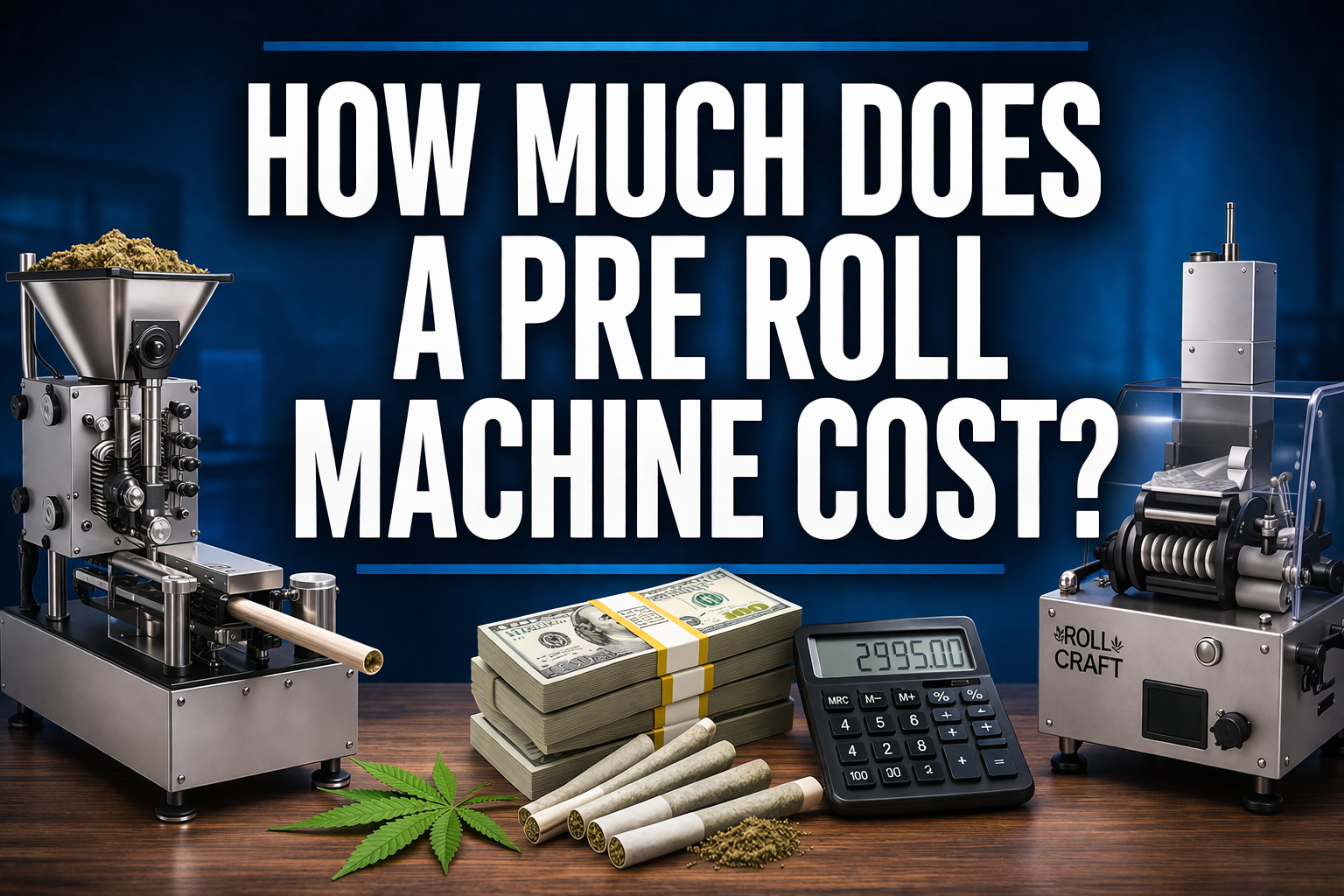
Pre roll machine cost is an important item of consideration when shopping for equipment.
Hand-filling 1,000 pre-rolls a day doesn’t just cost time. It can burn 6 to 10 labor hours daily, depending on your process and rework rate.
That’s why the real question isn’t “What’s the cheapest machine?”
It’s “What’s the cheapest way to hit volume without betting the farm?”
Let’s break down what pre-roll machines cost in 2026, what moves the price up fast, and where RollCraft fits.
Quick answer: pre roll machines usually cost $2,000 to $275,000+
Most pre-roll machines land in a wide range, from around $2,000 for basic tools up to $275,000+ for full automation systems.
That sounds like a useless range until you tie it to one thing.
How many steps you want the machine to handle.
Think of it like buying a “kitchen setup.”
A toaster costs less than a full restaurant line.
Pre-roll equipment works the same way.
Pre Roll Machine Cost tier 1: Manual and “starter” tools (about $2,000 to $6,000)
This tier is for teams still doing most work by hand, but trying to stop the bleeding.
Common examples include cone loaders, tamping tools, and batch-style fillers. One well-known option is the Futurola Knockbox, which is often sold as a semi-automated cone filling workflow.
What you’re paying for in this tier
- A faster way to fill cones in batches
- A more repeatable pack than pure hand work
- A smaller price tag that fits early scaling
What still costs you money
- You still need people doing setup, distribution, cleanup, and constant monitoring
- Weight drift still shows up when grind and moisture shift
- “One bad tray” can turn into 100 rejects fast
If your daily target is 500 to 2,000 pre-rolls, this tier can be a bridge. It’s rarely the finish line.
Pre Roll Machine Cost tier 2: Craft-scale automation (about $3,500 to $30,000)
This is where the buying gets serious, because the labor math starts to flip.
RollCraft MRB Pre Roll Machine Cost: $3,500
RollCraft’s MRB pre roll filling machine is priced at $3,500 and is built to fill fast without forcing you into a giant system. It’s rated up to 143 pre-rolls per minute, weighs 26 lbs, uses patented Nitrogen Enhanced Particle Lock filling technology, and does not require pre-weighing. It’s also Made in America with durable non-plastic construction, and it’s designed to be modular so you can start small and scale.
That “no pre-weighing” point matters more than it sounds. If you’ve ever staged hundreds of weighed shots on a table, you already know why.
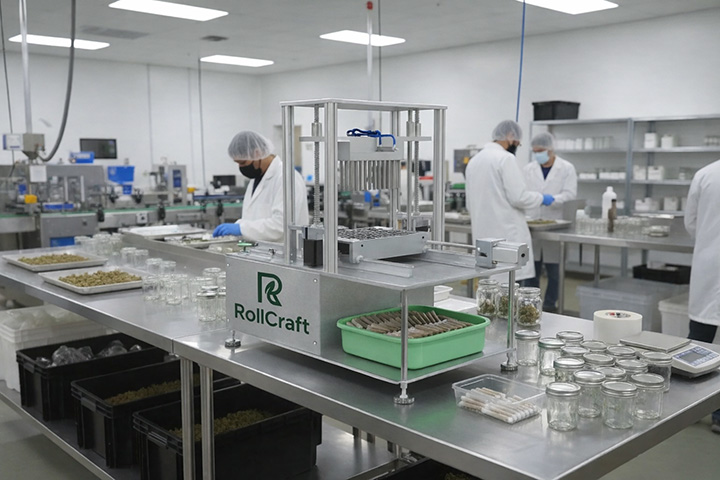
RollCraft ATC Pre Roll Machine Cost: $24,995
If you sell Dutch crowns, closure becomes your bottleneck right after filling.
RollCraft’s ATC automated Dutch Crown closing machine is $24,995.
MRB + ATC bundle: $29,995
Together, the bundle is $29,995, which creates a practical fill-and-close line for craft and mid-market producers.
A simple way to picture this tier is a small coffee shop.
You don’t buy a stadium espresso line. You buy the next piece that removes the daily choke point.
That’s what craft-scale automation is for.
Pre Roll Machine Cost tier 3: Full-line and enterprise automation (about $60,000 to $275,000+)
This tier exists for operations pushing massive daily quotas and trying to automate almost every step.
You’ll see systems advertised around $120,000 and beyond, often tied to high hourly output targets and premium finishing options.
Here’s the honest part that small operators feel in their gut.
All-in-one machines often assume you have:
- space for a dedicated line
- trained techs or maintenance support
- enough daily volume to keep the machine fed all day
- cash flow that can handle a large capital hit
For a craft producer in places like New York, New Jersey, Maryland, Ohio, or Missouri, that can be a mismatch. Your demand can jump, then stall, then jump again. Your equipment still needs to pencil out on the slow weeks.
This is why modular approaches keep showing up in real facilities. You buy capacity in steps, not in one swing.
What actually drives the price
If two machines both “fill cones,” why is one $3,500 and another $150,000?
These are the biggest cost drivers.
1) Throughput targets
Vendors price around output. If you need 1,000 pre-rolls per hour, you’ll pay more than a setup built for smaller daily runs.
A quick gut check:
- If you sell 2,000 pre-rolls per day, chasing a monster system can leave you paying for unused capacity.
- If you sell 20,000 per day, underbuying can trap you in overtime.
2) How many steps are automated
Filling is one thing. Closing, finishing, and infused workflows can add new machines and new cost.
For example, infusion-focused systems can be sold around a stated output like 600 pre-rolls per hour.
3) Labor replacement
A $15,000 machine that saves 30 labor hours per week often beats a $6,000 tool that saves 6 hours.
Not because the bigger one is “better.”
Because payroll doesn’t care.
4) Changeovers and training time
If your team runs 6 SKUs and switches cone size, strain, and grind daily, the cheapest machine can become the most expensive one. You pay in resets, jams, and retraining.
A simple ROI way to think about it
No spreadsheets needed. Use rough math.
- Pick your daily target. Example: 5,000 pre-rolls/day
- Write down your labor today. Example: 3 people x 6 hours = 18 hours/day
- Multiply by a loaded labor rate. Example: $22/hour
- Your labor spend is 18 x $22 = $396/day
- Weekly, that’s about $1,980 if you run 5 days.
Now compare that to equipment.
- If a machine costs $3,500, it doesn’t need to save much time to make sense.
- If a system costs $120,000, you need real volume, stable demand, and a plan to keep it busy.
This is also where modular equipment helps. You can add capacity as demand proves itself.
How RollCraft fits into the “competitor” picture without the drama
You’ll see competitors across three buckets:
- Batch-style fillers that speed up manual work
- Specialty machines that automate a key step like closing or infusion
- All-in-one lines built for high volume facilities
RollCraft sits in the craft-scale automation lane.
- MRB at $3,500 gives an entry point for real filling speed and repeatability.
- ATC at $24,995 targets a finishing step many teams struggle to staff reliably.
- The $29,995 bundle is a clear capex number you can plan around.
This isn’t about trashing big systems. Big systems make sense in the right building.
It’s about fit.
Buying a machine that assumes enterprise staffing and enterprise volume can feel like buying a tour bus when you run a local delivery route.
Why your location changes the “true cost”
Your machine price might be the same in every state. Your total cost won’t be.
Three location-based factors show up fast:
- Labor market: In higher-wage regions, saving 10 hours/week hits harder.
- Compliance pressure: Markets with tighter packaging rules raise the cost of rework.
- Seasonality: Some states see demand spikes that punish manual workflows.
If you’re in a newer market, modular scaling is a safer way to grow. You buy the next bottleneck, then reassess after 60 to 90 days of real demand.
The next question to ask before you buy
Ask this out loud:
“What’s my next bottleneck after filling?”
Because it’s rarely just filling.
It’s closing. It’s staging cones. It’s rework. It’s the one employee who “knows the trick” and calls out on Friday.
RollCraft pricing starts at $3,500 for the MRB, and $29,995 for the MRB + ATC bundle.
If you want pricing and a clean recommendation based on your daily target, do this:
- Write down your pre-rolls per day
- Write down your cone sizes and SKU count
- Write down your headcount on the line today
Then request a quote or call sales. You’ll get to a real number fast, without guessing.
Comments are closed